‘Bad Girls’ in Postinternet Art: Femininity, Feminism and the Ambivalence in Between
Academic Talk & Discussion
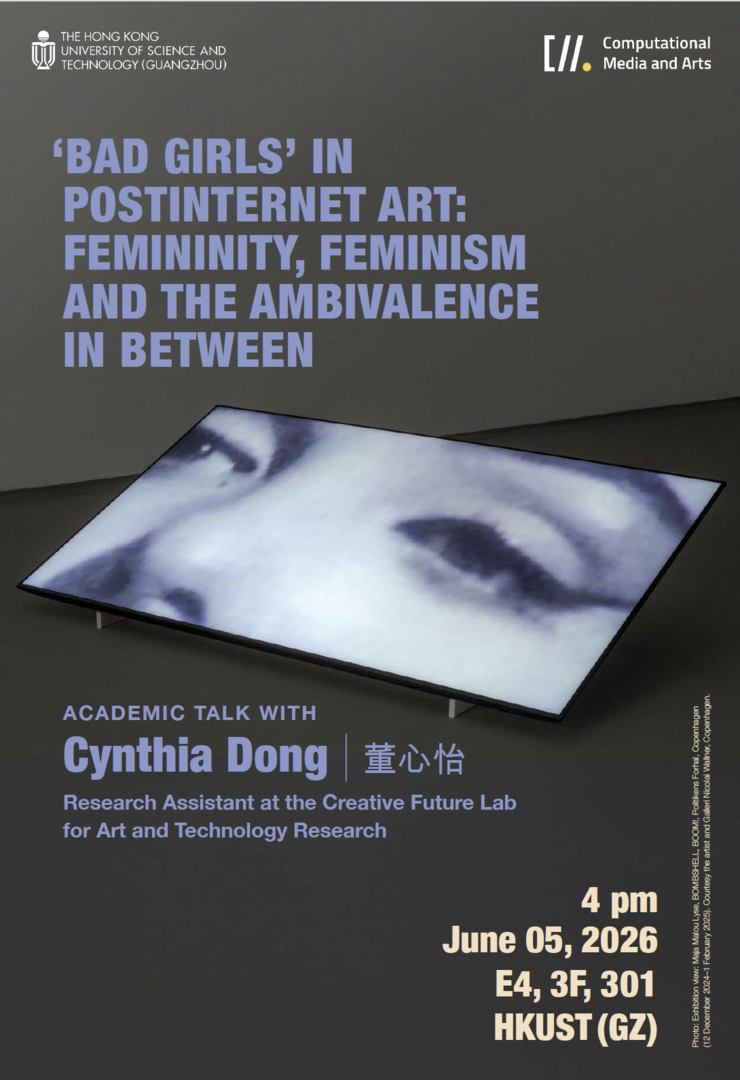
With her academic talk on Bad Girls’ in Postinternet Art: Femininity, Feminism and the Ambivalence in Between Cynthia Dong will introduce her current research project, that examines contemporary artists whose practices embody ambivalent and often ‘problematic’ forms of youthful femininity within a postinternet culture shaped by social media platforms, constant visibility, rapid image circulation, and intensified affective responses (Archey & Peckham 2014). She asks: why has there been a renewed fascination with girly aesthetics since the 2010s, particularly that of the ‘bad girl’? How do these artistic practices complicate the relationship between femininity and feminism beyond the binary of ‘good’ versus ‘bad’ feminism? And how does the postinternet condition shape both this resurgence and the ways these works are interpreted and contested?
Through close analyses of the practices of Maja Malou Lyse, Sara Cwynar, Mindy Seu, and the everyoneisagirl collective, as well as their reception across online platforms, and through engagement with theories of postfeminism, neoliberal feminism, popular feminism, and affect theory, the project contributes to feminist art history by reintroducing ambivalence, following the legacy of the 1994 Bad Girls exhibition. More broadly, the project explores ways of coping with contradiction and uncertainty without collapsing into either moral purity or empty performance, and provides a model for how we might study politicised identities when politics are increasingly negotiated through images and performances of correctness.
Cynthia Dong is currently a Research Assistant at the Creative Future Lab for Art and Technology Research. Her background is in media studies, film studies, and cultural analysis, with training at the Universities of Amsterdam and Cambridge. Her work engages with feminisms, queer theory, girlhood studies, artists' moving image, coming-of-age cinema, and popular culture. In autumn 2026 she will begin her PhD in the History of Art at the University of Warwick, UK, supported by a Chancellor's Scholarship. Her PhD research project explores 'bad girls' whose artistic practices combine girlishness with attachments to 'problematic' representations of femininity within a post-internet culture shaped by social media platforms, constant visibility, rapid image circulation, and intensified affective response. The focus is on the ambivalence between femininity and feminism, focusing on in art produced under postinternet conditions.