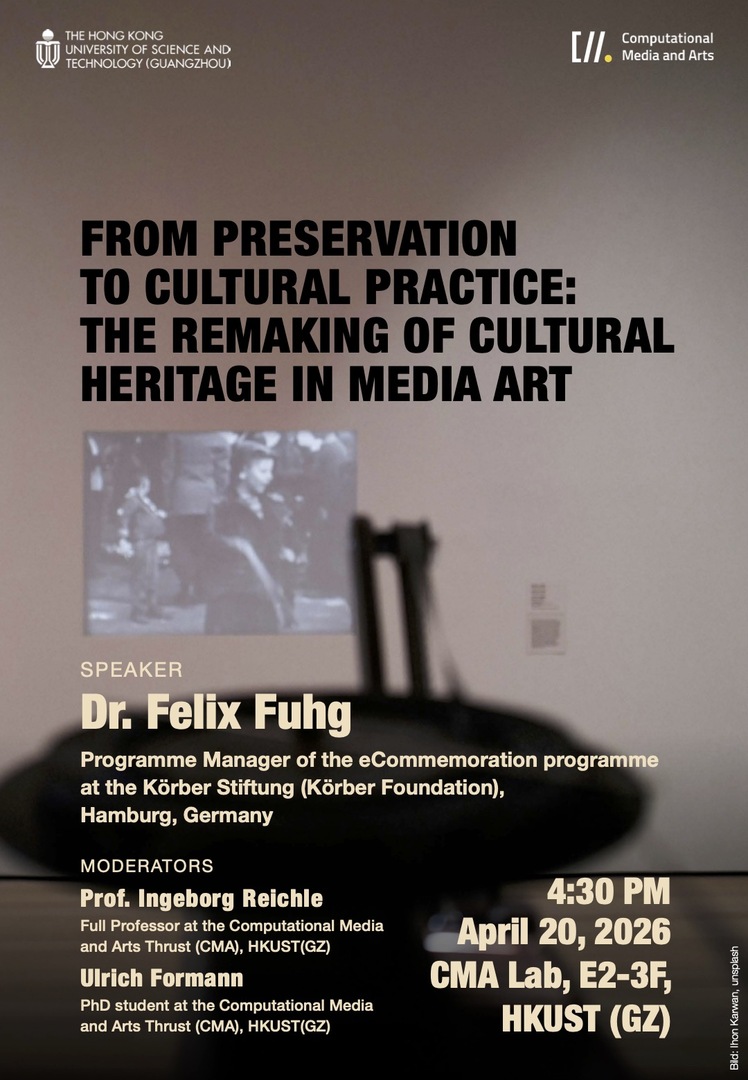
From Preservation to Cultural Practice: The Remaking of Cultural Heritage in Media Art
Academic Talk & Discussion
The past plays a crucial role in shaping national, regional, and global identities. History has become a major source for establishing a framework that enables us to evaluate the present and imagine the future. To do this, we often refer to (im-)materialised relics of the past that we have identified as the heritage of our communities, nations, continents, or our world as a place we all share.
By intervening in contemporary discourse, media art has reignited the debate about the 'givenness' of heritage. Which institutions and discourses determine what becomes heritage? How has heritage become a flexible entity that is shaped, retold, and reimagined through the arrival of new media and technologies?
This talk examines media art projects that are redefining our understanding of heritage. In doing so, we explore the new possibilities of preservation that have been introduced by new technologies, as well as the new challenges they present, such as questions of ownership and copyright. We examine the role that AI plays in remodelling, reinterpreting, and bringing to life heritage that has not been stored in the world’s museum collections. We also explore how the meaning and understanding of heritage has evolved in an era in which the digital immaterial has become a shaping force.
Dr. Felix Fuhg is a curator, museologist, and historian whose research focuses on the history of popular cultures. He holds a PhD from Humboldt University Berlin. He explores ways in which the past can be experienced through media. His work centres on historical issues and forms of remembrance in contemporary art and media cultures, and he curates the eCommemoration programme at the Körber Foundation in Hamburg, Germany. The programme explores how memory cultures have changed in the digital age, with a particular focus on interventionist art and investigative aesthetics.