Image Neuroscience and the Arts
German-Sino Conference in Shanghai
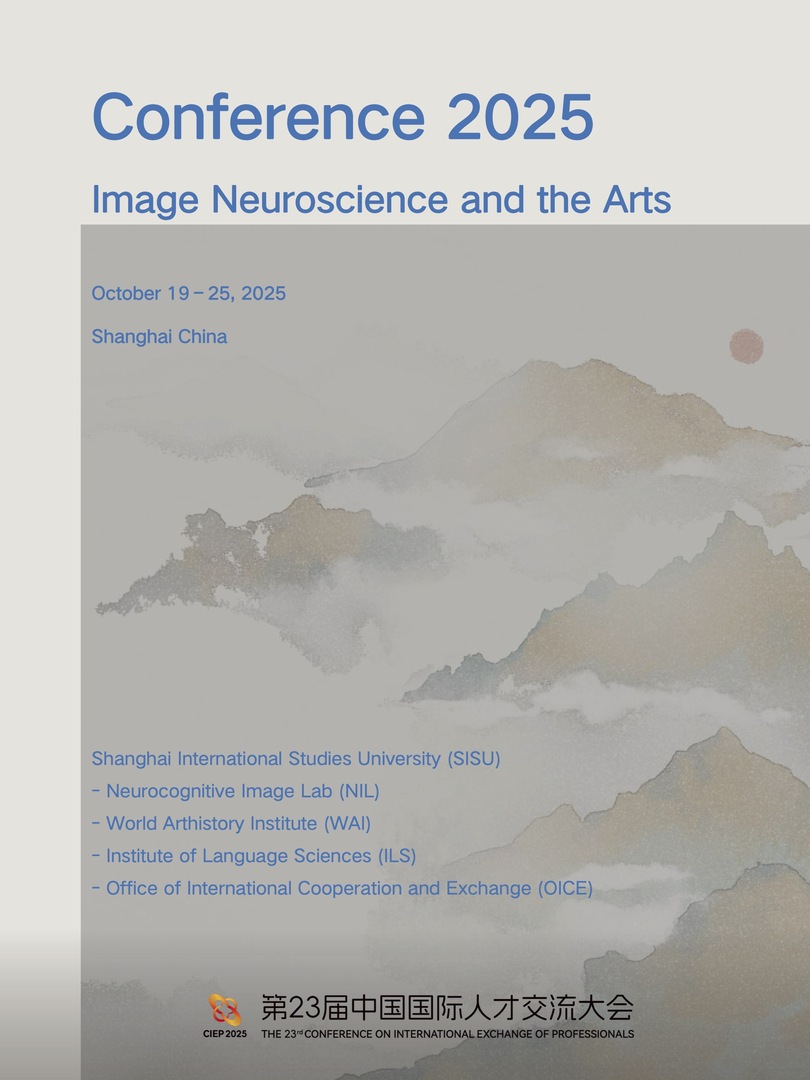
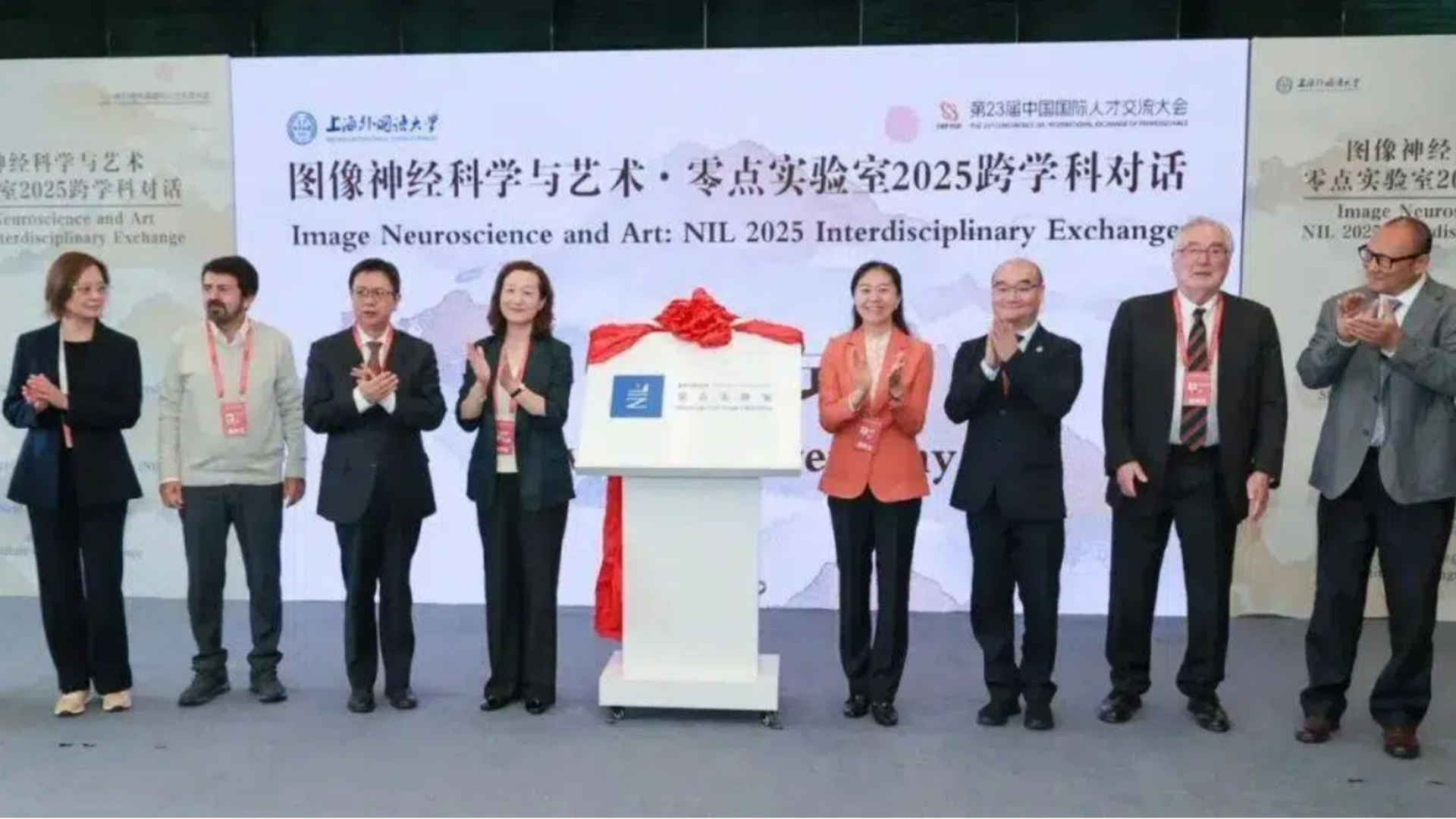
From October 19-25 Ingeborg Reichle participated in the Shanghai conference "Image Neuroscience and the Arts," giving a keynote about her research focus on Art in the Age of Technoscience. The German-Sino event was organized by Ernst Pöppel (Munich, Germany) and Yan Bao (Shanghai, China), both directors of the Neurocognitive Image Lab (NIL) at the Shanghai International Studies University (SISU). The conference was embedded in the 23rd Conference on International Exchange of Professionals 2025 and organised by the World Arthistory Institute (WAI), the Institute of Language Sciences (ILS) and the Office of International Cooperation and Exchange (OICE) in cooperation with the Institute of Medical Psychology at Ludwig-Maximilian University Munich, Germany.
The emerging discipline of Image Neuroscience is representing a frontier of scientific inquiry into the neural basis of aesthetic experience, creative expression, and visual perception. Neuroscientists, artists, theorists, and curators were gathering at the conference presenting rigorous examination of topics including the neural correlates of aesthetic judgement, the creative process as a brain state, the impact of digital art on neural plasticity, and the application of these insights in therapeutic and technological contexts.
Speaker were Claus-Christian Carbon, Riccardo Brunetti, Stefan Thurner, Chor Kiu Raymond Chan, Andrew Luo, Oscar Arias-Carrión, Mihai Avram, Beata Bajno, Zaira Catteneo, Franco Delogu, Violeta Dinescu, Mikhail Filippov, Jörg Fingerhut, Anne Giersch, Virginie van Wassenhove, Evgeny Gutyrchik, János Györi, KyungHun Han, Michael Heinrich, Caroll Hermann, Morteza Izadifar, Jakob Izbicki, Hennric Jokeit, Manuel Lima, Juan Lupiáñez, Daniel Keeser, Marek Kuś, Nicolae Manolache, Daniel McNamee, David Melcher, Galina Menshikova, Veronika Nourkova, Elvira Barkhatova, Olga Buivolova, Helena Gao, Aneta Szymaszek, Ovid J.L. Tzeng, Vera Zabotkina, Marco Paolini, Yanna Popova, Catarina Ramos, Ingeborg Reichle, Maria Reinisch, Jacek Rogala, Eva Ruhnau, Tilmann Sander-Thömmes, Kerstin Schmidt, Kazuhisa Shibata, Alexey Sozinov and Yuri Alexandrov, Martin Troendle, Wolfgang Tschacher, Jan Vasbinder, Ernst Wagner, Marc Wittmann, Bassem Younes, Andrzej Herczynski, Yuliya Zaytseva, and Alexander Zehnder.
The Shanghai-based Neurocognitive Image Lab (NIL) aims to build up an international and interdisciplinary research hub at the forefront of brain science, neuro-aesthetics, and image science. It will explore how the brain encodes visual images, temporal and spatial information, and experiences aesthetic beauty, advancing innovative theories and applications in neuroscience, art and intelligent interaction. The lab will foster via Horizontal Interdisciplinarity connections across diverse fields to discover novel, "unasked questions"—the hallmark of creative research. Bridges in Horizontal Interdisciplinarity are built to linguistics with the focus on different language competences, to the humanities in general including philosophy, to artificial intelligence and robotics, to technological applications harvesting “unused answers”, to different medical fields like neurology or psychiatry, to art history identifying the cultural differences, to the arts as represented in poetry, music, architecture or visual art. Vertical Interdisciplinarity drives down to the neural mechanisms that underlie subjective phenomena and behaviour. Using advanced imaging technologies (MEG, fMRI, EEG) and sophisticated analytical tools, NIL aims to investigate processes like temporal processing and spatial cognition. Crucially, thus research will be conceptually framed within an aesthetic context, making neuro-aesthetics a central pillar of NIL's identity. By uniting this vertical dive into neural mechanisms with a horizontal expansion across the vast landscape of human knowledge, NIL will open a new chapter in interdisciplinary science. This powerful synergy will not only illuminate the profound connections between brain, image, and aesthetics but also catalyse a future of both fundamental discoveries and practical applications that redefine our understanding of the human experience.