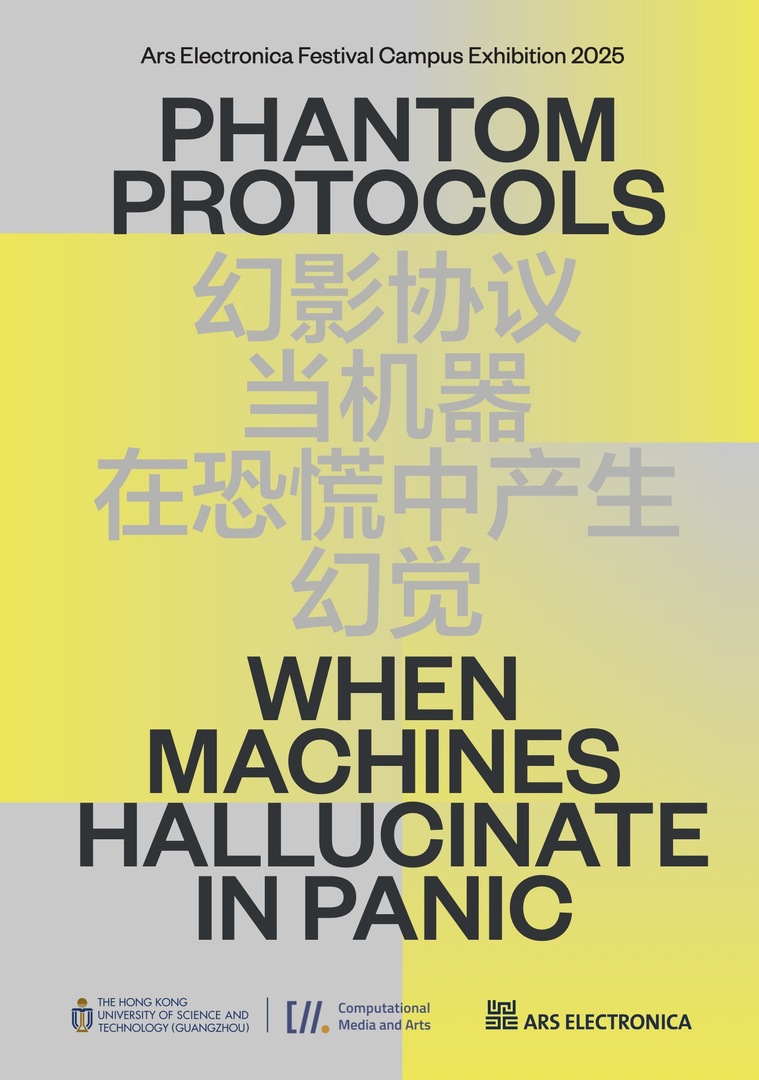
Phantom Protocols: When Machines Halllucinate in Panic
CMA at the Electronica Festival Campus Exhibition in Linz, Austria
In September, 2025 Ingeborg Reichle co-curated the CMA exhibition for this year`s Electronica Festival Campus Exhibition Phantom Protocols: When Machines Hallucinate in Panic, shown in Linz, Austria, from September 3-7, 2025. Phantom Protocols gathered five artworks by CMA students, setting up a laboratory for radical art-tech futures and showing art works that disrupt the hidden architectures of control — ecological, algorithmic, and psychological. Each project mapped a threshold: when human sovereignty glitches, when animals enter the feedback loop, when machines generate languages and logics of their own.
The curatorial team of the exhibition consists of three CMA faculty members, including James She (lead) Clea von Chamier-Waite, and Ingeborg Reichle.
The CMA exhibition will show a number of art works, including “Drift of the Uncharted” by Ary-Yue Huang, Wenzong Ma, and Bingyuan Wang, “Algorithmic Miner” by Jia Sun and Zheng Wei, “Capillary Network” by Hanlu Ma, Hengyu Meng, Robert Jankowski, Ziwei Wu, Jindu Wang, and Tianrui Hu, “Machine Civilization” by Yixiong Wang, Hourun Wang, Jiaqi Shi, and Yufeng Zeng, and “Chimpanzee, Run!” by Siyuan Liu.
Drift of the Uncharted by Huang Ary-Yue, Ma Wenzong, and Wang Bingyuan features a quadruped robot carrying a projector that casts a submerged urban landscape into a darkened space, simulating a future transformed by rising sea levels. As it moves, the robot controls the virtual camera, guiding viewers through a speculative flooded world. Merging physical and digital realms, the work combines climate data, real-world scans, and CGI seawater to immerse audiences in the potential realities of climate change.
Algorithmic Miner by Jia Sun and Wei Zheng is a VR-based interactive art installation that exposes the invisible and repetitive labor behind AI development — specifically, the data annotation work that powers machine learning. Through immersive tasks and symbolic visuals, the installation prompts participants to experience the monotony and alienation of data labeling, reflecting on how human creativity is exploited within AI systems. The work raises questions about labor, agency, and ethics in our increasingly automated world.
Capillary Network by Hanlu Ma, Hengyu Meng, Robert Jankowski, Jindu Wang, Tianrui Hu, and Ziwei Wu is an interactive data art installation that visualizes the unseen circulation of toxic substances across ecosystems. Tracing pesticide contamination in wildlife, invertebrates, companion animals, and humans, the work reveals an intricate web of exposure and interdependence. Like an invisible capillary system, toxins flow through bodies and landscapes, dissolving species boundaries and forging unexpected alliances of harm. Participants engage with this shifting network, witnessing how contamination seeps through biological and artificial systems, shaping shared vulnerabilities.
When humans first carved symbols into stone, history took shape, thoughts were passed down, and civilization was born. This inspires Machine Civilization by Yixiong Wang, Hourun Wang, Jiaqi Shi, and Yufeng Zeng, which explores the possibilities of language sovereignty and non-human cultures that may continually evolve beyond us. This artwork imagines robot observers as the “first recorder” of an emerging civilization. Driven by mechanical curiosity, it roams the city, endlessly identifying, collecting, and documenting natural and man-made objects, scenes, and behaviors. These visual fragments are transmitted in real time to a closed AI Parliament, where multiple artificial agents — each with its own evolutionary strategy and language model — analyze, debate, and negotiate. In doing so, they gradually generate their first scripts, which continuously transform and expand. Ultimately, these evolving inscriptions are etched into ‘Stele Zero,’ symbolizing the first stone of an autonomous machine civilization. Machine Civilization poses a question: when machines start to inscribe their own evolving narratives, how does this reshape our understanding of meaning, memory, and future agency?
Chimpanzee, Run! by Siyuan Liu is an educational game highlighting the imminent extinction of chimpanzees due to poaching, habitat loss, and illegal trade. Set in 2048, players navigate a perilous world where choices shape the fate of the last surviving chimps. As the environmental crisis deepens, the game challenges players to confront humanity’s role in this impending disaster — pushing them to question whether our desires justify the destruction of wildlife, or if change can still be enacted.