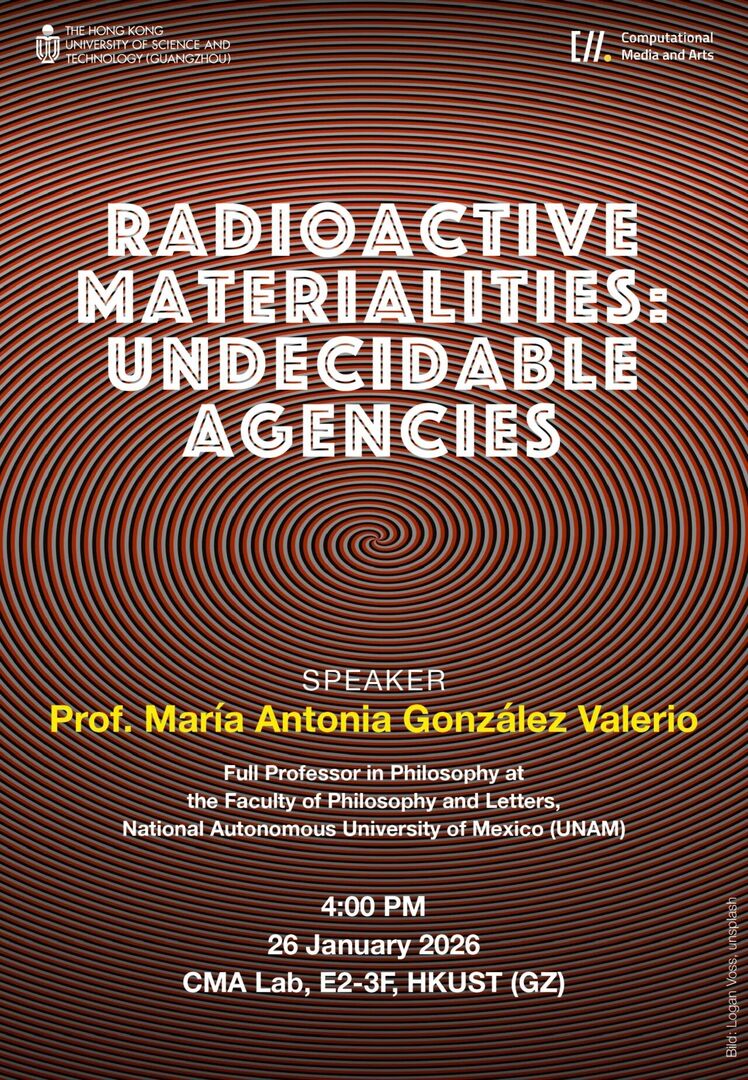
Radioactive Materialities: Undecidable Agencies
Academic Talk
Grounded in an approach at the intersection of art and science, this CMA talk by Mexican Philosopher María Antonia González Valerio explores how artistic practices can critically engage scientific knowledge in order to rethink materiality, agency, and time.
By examining scientific practices through artistic forms, and by emphasizing art’s capacity to reveal the qualities and effects of materials, the lecture focuses on how radioisotopes and other anthropogenic materialities challenge dominant conceptions of temporality. Drawing on cases such as Hiroshima, Chernobyl, and Fukushima, as well as nuclear testing, technological accidents, and industrial waste, the lecture shows that radioactivity does not follow linear or homogeneous timelines. Instead, it generates multiple, uneven, and contingent temporalities.
Elements such as cesium, plutonium, and strontium do not simply accumulate in soil, water, and bodies; they transform these environments into living archives marked by injury, illness, and transgenerational effects. From this perspective, time can no longer be understood as a purely measurable parameter. Rather, it must be conceived as an open and indeterminate set of processes unfolding across generations, territories, and ecosystems.
This CMA talk, therefore, proposes shifting attention away from isolated objects or individual entities toward agencements: collective configurations composed of materials, forces, bodies, and environments.By bringing philosophy, history, and art into dialogue, the lecture reflects on how anthropogenic materialities impose irreversible conditions on contemporary experience and on the production of the world.
María Antonia González Valerio, PhD is a Philosopher and Professor at the National Autonomous University of Mexico (UNAM). She works within the research areas of ontology aesthetics, and interdisciplinary arts, sciences, and humanities. She is the Head of the research group Arte+Ciencia (Art+Science), which brings together artists, scholars, and scientists in interdisciplinary work that produces education at the undergraduate and postgraduate levels, specialized theoretical research, artistic productions, and exhibitions.
She is the author of the books Through the Scope of Life. Art and (Bio)Technologies Philosophically Revisited (Springer, 2023), Cabe los límites: Escritos sobre filosofía natural desde la ontología estética (México: UNAM/Herder, 2016), Un tratado de ficción (México: Herder, 2010), and El arte develado (México: Herder, 2005).