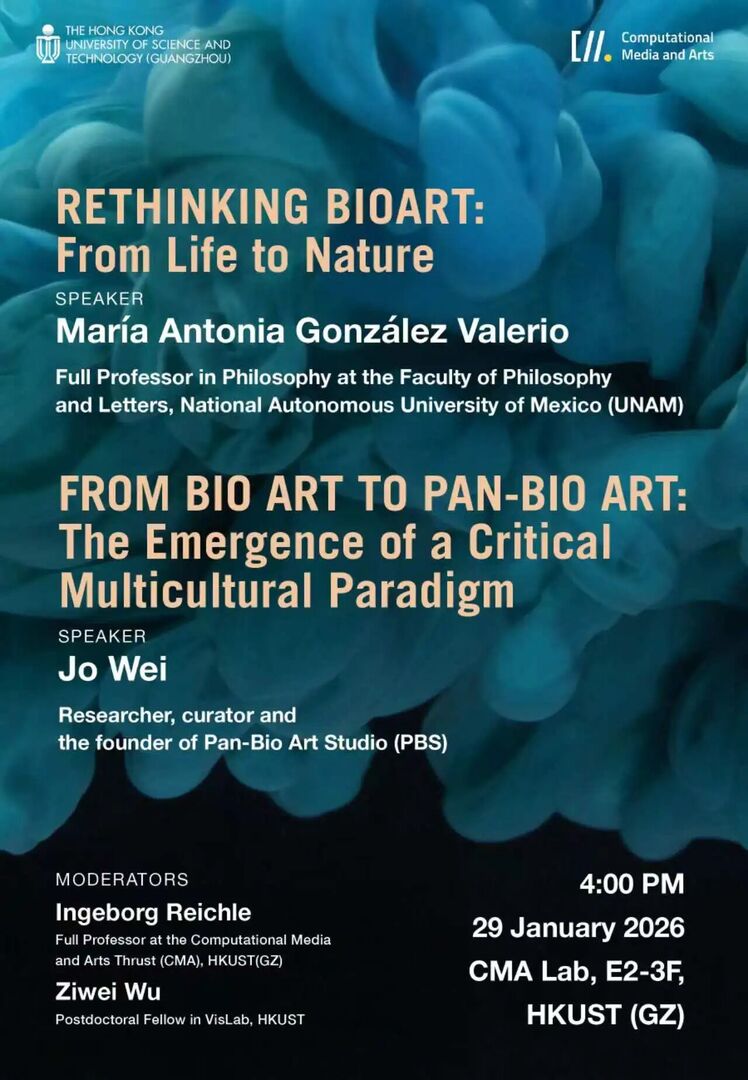
Rethinking Bioart: From Life to Nature
Academic Talks & Discussion
The CMA talk Rethinking Bioart: From Life to Nature by Mexican philosopher María Antonia González Valerio will reflect on more than fifteen years of transdisciplinary practice developed by Arte+Ciencia (A+C) and the artistic collective Bios ex Machina at the National Autonomous University of Mexico (UNAM). Speaker María Antonia González Valerio is using this long-term experience as a lens to rethink the role of art–science practices in the urban Anthropocene. Rather than presenting a single body of work, the talk proposes a conceptual journey through shifting notions of life, nature, and knowledge production at the intersection of art, science, and the humanities.
Beginning with early bio art experiments focused on genetic manipulation and laboratory aesthetics, the talk traces a gradual displacement of “nature” from the controlled spaces of the lab into the contested terrains of the city. This transition foregrounds how biological, ecological, and cultural processes become entangled within urban environments, especially in the context of Mexico City as a megalopolis shaped by ecological fragility, political tensions, and social inequalities.
Drawing on historical reflection, theoretical inquiry, and situated artistic research, the talk will explore how concepts such as biological episteme, epigenetics, and the nature–culture divide are challenged through collaborative, community-based practices. Particular attention is given to sites where life persists and reorganizes itself under pressure, revealing forms of resilience, resistance, and transformation that escape dominant narratives of urban development.
Ultimately, speaker María Antonia González Valerio will argue for an expanded understanding of life and nature—one informed by transdisciplinary art–science methodologies capable of generating new modes of perception, collective imagination, and critical resistance. In doing so, it positions artistic research not merely as representation, but as an active agent in rethinking how we inhabit, sense, and respond to the urban Anthropocene.
From Bio Art to Pan-Bio Art: The Emergence of a Critical Multicultural Paradigm
Biotechnology and artificial intelligence are profoundly shaping society today, driving the evolution of new paradigms in the humanities and arts. The term "Bio Art" emerged in 1997, defined using biological materials as media and the manipulation of life processes. However, early Bio Art often exhibited anthropocentric tendencies and remained confined to Euro-American cultural contexts.
Based on this foundation, Beijing-based curator Jo Wei will propose in her CMA talk From Bio Art to Pan-Bio Art: The Emergence of a Critical Multicultural Paradigm the term “Pan-Bio Art” by integrating creative trends over the past two decades. This concept reflects the evolution of the integration of biology and art in cultural contexts, featuring anti-reductionism, a critique of technological determinism, multiculturalism, and a focus on bioethics. Pan-Bio Art diverges from traditional Bio Art in terms of ontology, technological approaches, sites of practice, ethical frameworks. As an evolving field, Pan-Bio Art addresses a wide range of concerns: mapping the history of existing Bio Art, exploring the impacts of emerging biotechnologies on art and society, engaging in contexts of technodiversity, and promoting interdisciplinary dialogue.
Moderators
Ingeborg Reichle, PhD, is a contemporary art historian and cultural theorist. She is Full Professor at the Computational Media and Arts (CMA) Thrust at the Hong Kong University of Science and Technology (HKUST-GZ) in Guangzhou. Her research areas focus on new media art history and computational aesthetics as well as artistic responses to systemic risks and global challenges, including biotechnology and synthetic biology. She is the author of several books, including Art in the Age of Technoscience (Springer, 2009) and Plastic Ocean (De Gruyter Brill, 2021). Before joining the CMA faculty, she was a co-curator of the 4th Resonances Initiative NaturArchy: Towards a Natural Contract of the SciArt Project at the Joint Research Centre (JRC) of the European Commission in Ispra, Italy. In recent years she also served as Full Professor and Chair of the Department of Media Theory at the University of Applied Arts Vienna, Austria, and as a member of the Board of Trustees of the Centre for Art and Media (ZKM) in Karlsruhe, Germany.
Zi-Wei Wu, PhD, is a media artist and researcher. She holds a PhD in Computational Media and Arts from the Hong Kong University of Science and Technology and an MFA with distinction from Goldsmiths, University of London and a BA from the Chinese Academy of Art. Her practice and research focus on Artificial Life Art, examining the intersections of biology, science, and society through interdisciplinary methods. She is a winner of the Lumen Prize. Her research was published in the SIGGRAPH Art Program, ISEA, and the Artificial Life Journal of MIT Press. She has exhibited at international venues, including Ars Electronica, CYFEST, ACMI, and IEEE VISAP.