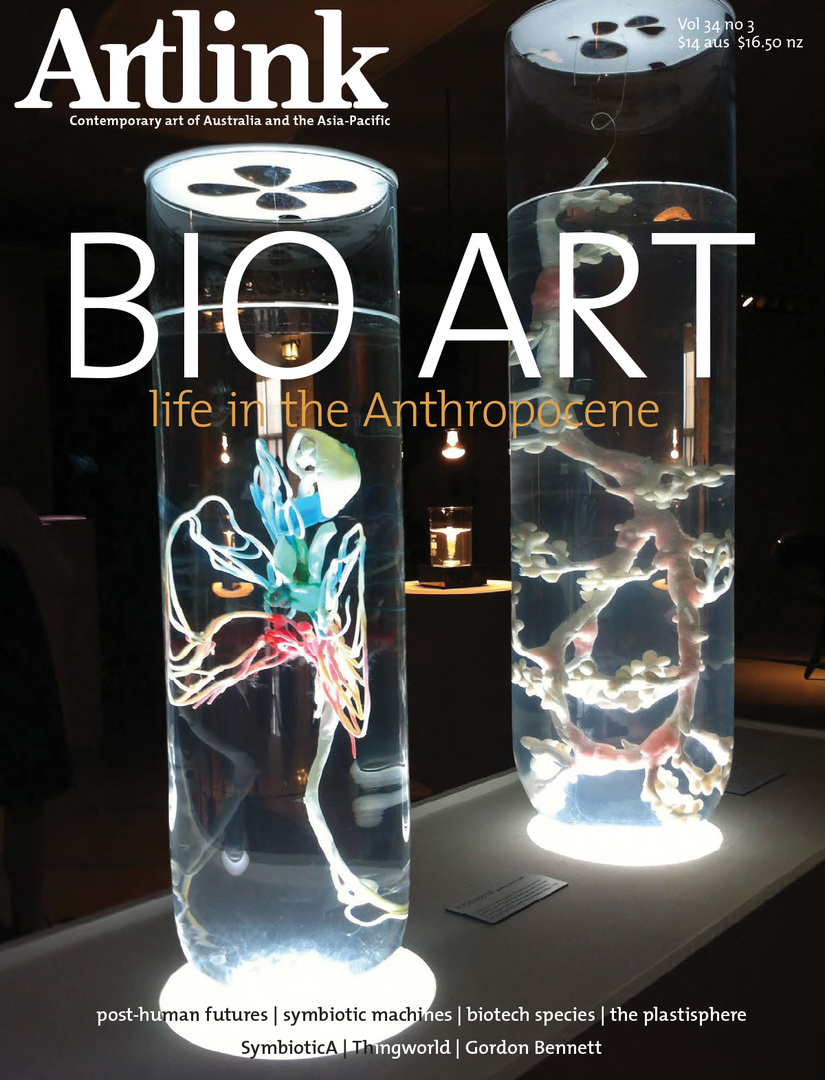
Speculative Biology in the practices of BioArt
Ingeborg Reichle
Ingeborg Reichle, "Speculative Biology in the practices of BioArt." In: Artlink. Contemporary Art of Australia and the Asia-Pacific: Bio Art: Life in the Antropocene, vol. 34, no. 3, 2014, pp. 30-34.
When BioArt received much attention around the turn of the millennium as a result of artworks like Eduardo Kac’s green rabbit, a transgenic animal that glowed in the dark under UV light, it unleashed a lively debate about whether biotechnology would become an artistic medium and whether the fine arts should engage with transgenic or cellular organisms. When BioArt pioneers like Joe Davis began to work with DNA in the late 1980s in projects such as Poetical Vaginal or Microvenus it was a major challenge to get access to scientific laboratories in an institutional context. Passing through the doors of institutions and getting access to a wet bench in a laboratory to go “hands-on” meant in those days a radical change of location. Moving from the studio into the laboratory provided the fine arts with a variety of new materials like bacteria, cells, tissue cultures, or transgenic organisms as a means of artistic expression, but this shift also made it necessary for artists to get acquainted with new epistemologies and the logic of the techno-scientific regime, which governs experimental bench work through protocols, techniques and methods, instruments and equipment, as well as a complex set of human and non-human agents and most notably with patents and the flow of global capital.
With the emergence of BioArt, biotechnology became part of the art world. By bringing cutting edge technologies closer to the public, BioArt has provoked wider reflection about the ethics of turning biology into technology and in particular has raised questions about the aesthetic and ethical status of manipulating living organisms. By showing transgenic organisms in galleries and museum contexts, BioArt drew attention to the fact, that biotechnology had already crossed the divide between the artificial and the natural back in the 1970s. Unsurprisingly, the selective manipulation of living organisms for artistic purposes provoked passionate debates about the shifting concept of life, a concept that has changed dramatically since the arrival of biotechnology within the frame of technoscience. Art emerging from the laboratory opened up non-normative debates about life and its limits in the crossover between BioArt, ethics, sciences, and the humanities, and also framed controversies about the growing influence of science and technology and a bioscience-based economy on our societies as well as on the fine arts.
Whereas in the early days BioArt primarily sought to reveal the state of the art of biotechnology or tissue engineering, current BioArt practices interrogate the limits, boundaries, frontiers, and frameworks within which life can exist and how fragile these limits are in an age that some have termed the Anthropocene. Altering nature deliberately using biotechnology – in a scientific laboratory or in the kitchen at home – is still a vital topic in BioArt. However, because we have transformed our entire planet in recent centuries into a kind of laboratory where traditional distinctions between natural and artificial, subject and object, human and non-human agents no longer hold when confronted by the enormous ecological problems and challenges that exist today, speculative biology is now becoming a major issue in BioArt.